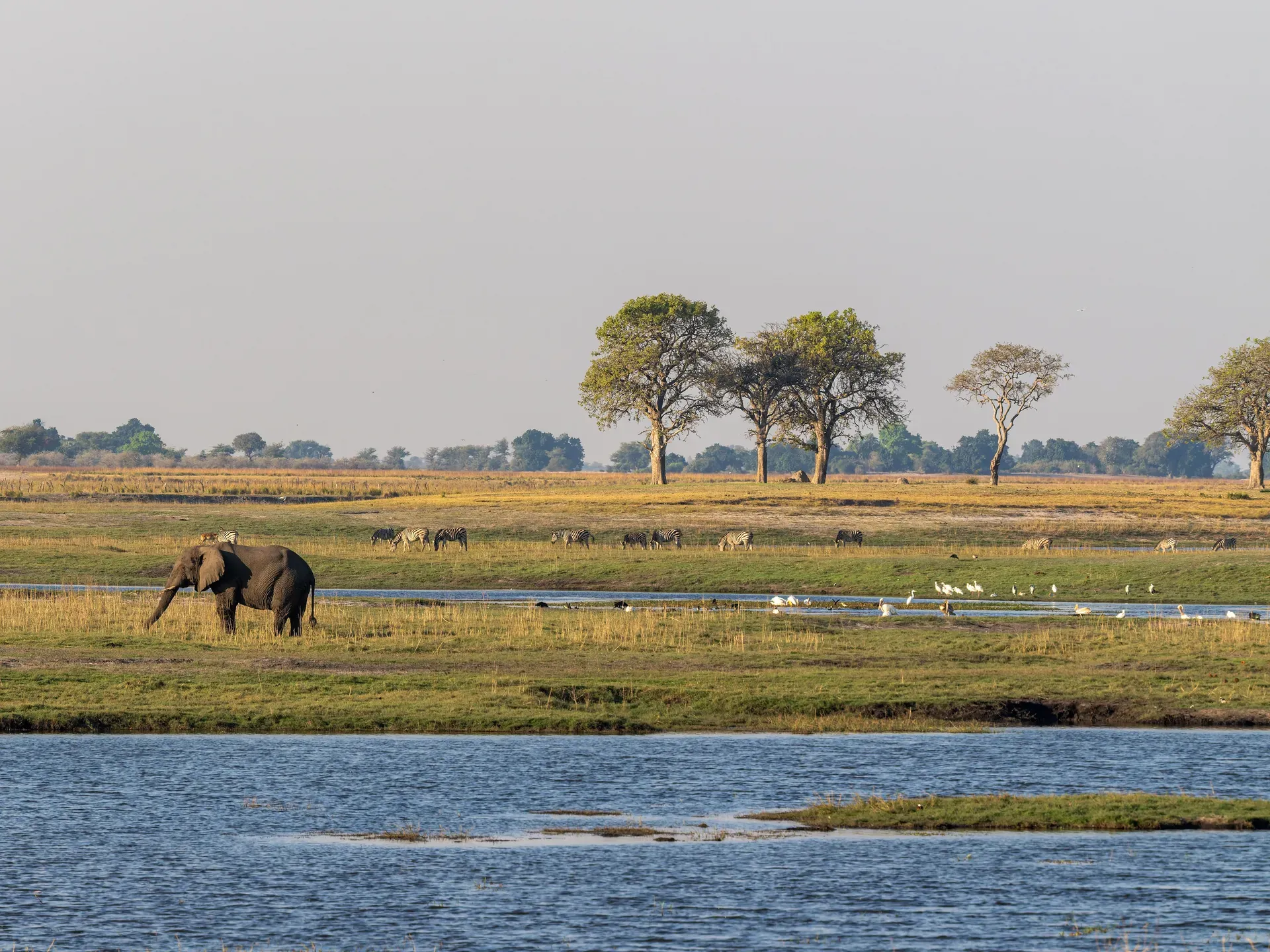
Chobe National Park stretches across 11,700 km² of northern Botswana along the Namibian border, holding the densest elephant population on Earth — an estimated 50,000 to 70,000 animals drawn to the Chobe River's permanent water.
Chobe National Park covers 11,700 km² of northern Botswana and holds the densest elephant population on Earth: an estimated 50,000 to 70,000 animals in and around its borders. The Chobe River runs along its northern edge, marking the boundary with Namibia's Caprivi Strip, and most visits launch from Kasane, a town 8 km from the main Sedudu Gate. The park is Botswana's third-largest and its most biologically diverse protected area.
It was proclaimed Botswana's first national park in 1967, the year after independence. More than 450 bird species have been recorded within its borders, and the lion prides of the Savuti Marsh have been documented hunting elephants — behaviour almost never seen elsewhere. In 2024 the park drew 276,400 paying visitors and collected over P30 million in entrance fees. It anchors the northern end of the Kavango–Zambezi (KAZA) Transfrontier Conservation Area, which links protected land across five countries, and the Chobe–Linyanti wetland system sits on UNESCO's tentative World Heritage list.
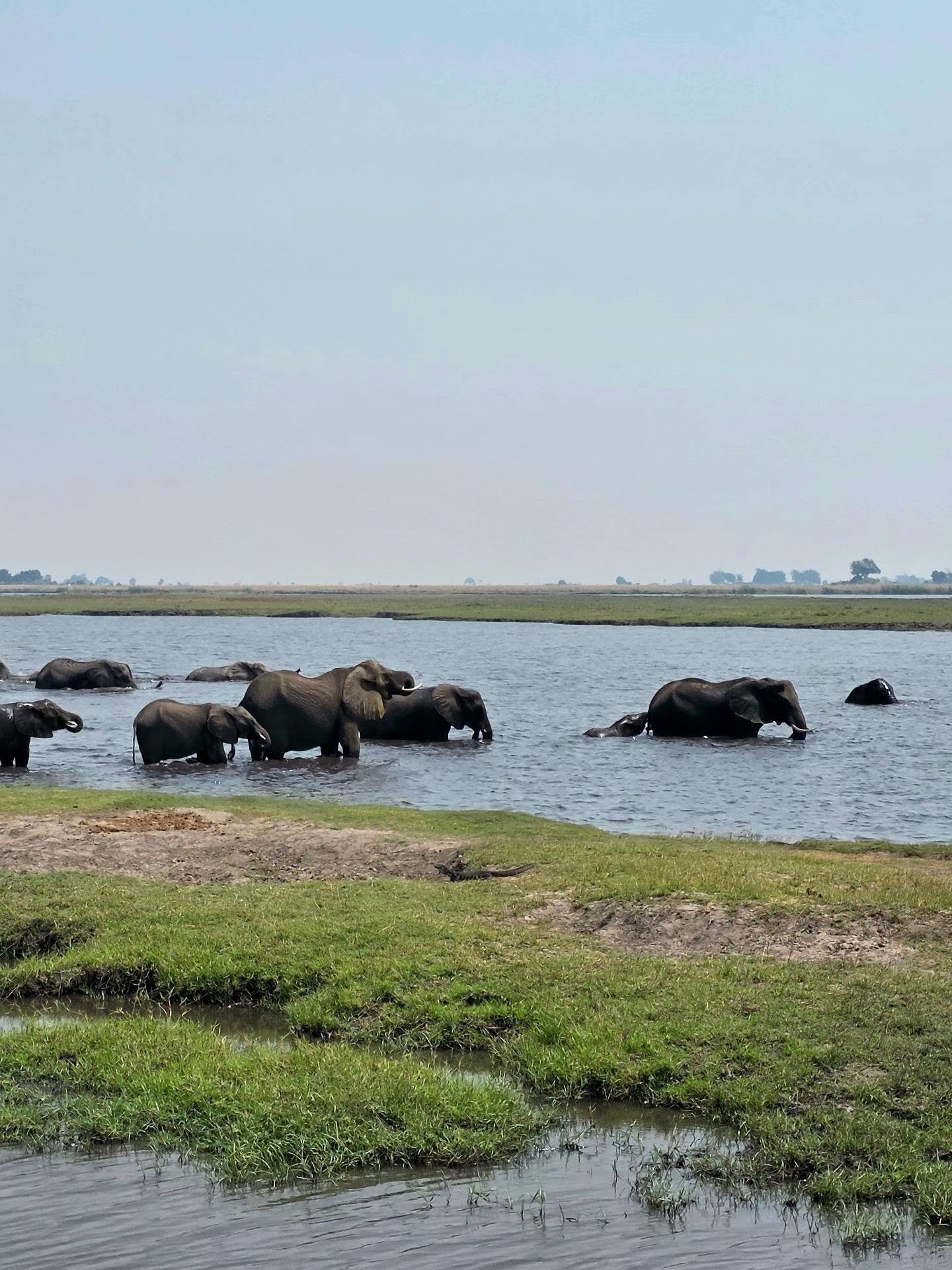
Four regions make up the park. The Chobe Riverfront in the northeast is where dry-season herds converge on permanent water, and groups of 60-plus elephants routinely cross the sandy track within metres of vehicles. The Savuti Marsh in the west is lion and hyena country. Linyanti's swamps hold the northwest corner, and the arid Ngwezumba pans fill the quiet interior. Most people take in two activities rather than drive deep: a 3-hour river cruise from Kasane (about US$40 per person) that drifts past hippos, fish eagles and swimming elephants, plus a game drive along the floodplain. Victoria Falls lies 80 km away across the Kazungula border, an hour by road, so Chobe slots neatly into any northern Botswana or falls itinerary.
San (Basarwa) hunter-gatherers lived here first, and their rock paintings survive in the rocky hills around Savuti — the oldest human record of the area. The push to protect the land began in 1931, when a national park was first proposed. A year later, in 1932, about 24,000 km² of the Chobe district became a non-hunting area, expanded to 31,600 km² in 1934. Then the project stalled. A heavy tsetse-fly infestation hit in 1943, and with sleeping sickness threatening the region, wildlife protection slid down the government's priorities for a decade.
Government interest revived in 1953, and in 1960 the Chobe Game Reserve was officially created, though smaller than the 1930s plan. Botswana became independent in 1966. The reserve was declared the country's first national park in 1967/68. What followed was a clean-out unusual even by the standards of African parks: industrial settlements were removed one by one, including the Serondela timber camp, which had logged the riverfront's hardwoods for years. By 1975 the park was entirely free of human activity. Two minor expansions, in 1980 and 1987, fixed today's 11,700 km² boundary.
Elephant numbers then climbed steeply. Wars and poaching in neighbouring Angola, Zambia and Namibia pushed herds into northern Botswana, where permanent water and strict protection made it the safest ground in the region. The 2022 KAZA Elephant Survey counted 131,909 elephants in Botswana, the largest national population in the survey area, and an estimated 50,000 to 70,000 of them use the Chobe ecosystem. The herds changed the park physically — much of the riverfront's Baikiaea and Afzelia woodland has been browsed back to scrub. Botswana's 2014 hunting ban, and its partial reversal in 2019, split opinion between communities living beside crop-raiding herds and conservationists who see the elephants as a national inheritance. Chobe, where the density is highest, sits at the centre of that argument.
The park is now Botswana's flagship tourism asset. The 276,400 visitors recorded between January and early October 2024 made it the busiest in the country, and gate fees feed directly into the national wildlife economy. A 2026 fee overhaul — international adult entry set to rise from BWP 120 to BWP 270 — was postponed on 31 March 2026, so the old rate still applies until the government moves again. Confirm at the gate. Further ahead sits the tentative UNESCO listing for the Chobe–Linyanti wetlands, which would place the whole ecosystem under World Heritage consideration.
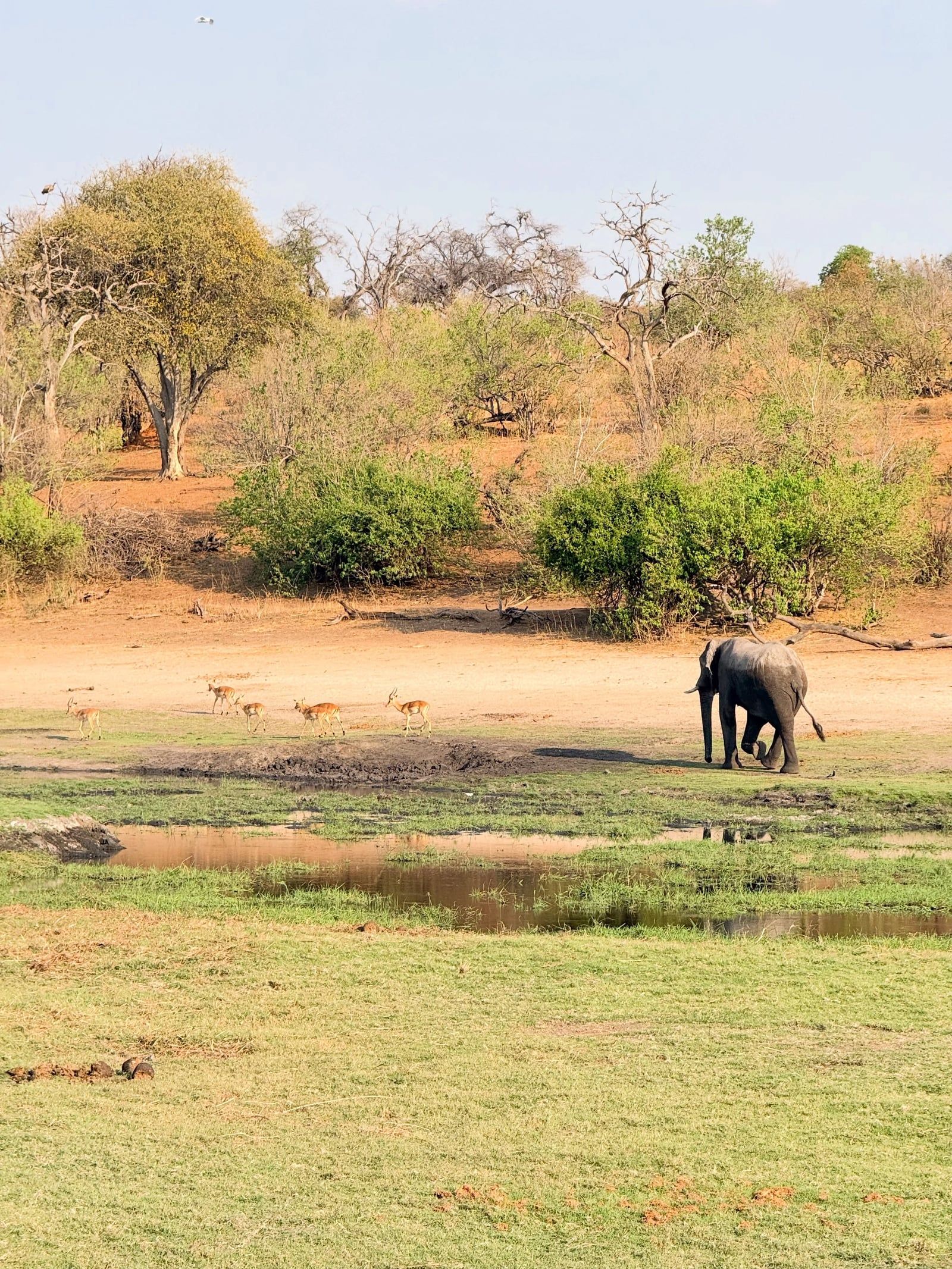
Four ecosystems sit inside one park boundary. The Chobe Riverfront (Serondela) in the northeast is lush floodplain and hardwood woodland — African teak (Baikiaea plurijuga) and Afzelia quanzensis — though decades of elephant browsing have cut the forest back hard. The Linyanti swamps and riverine forest hold the northwest, with open floodplain that concentrates elephant, red lechwe and predators in the dry months. The hot, dry Savuti region fills the west, and the arid Ngwezumba pans — including the Nogatsaa clay depressions — lie in the interior, where buffalo and elephant breeding herds roam between waterholes with barely another vehicle in sight.
The strangest feature is the Savuti Channel, a roughly 100 km watercourse that drops only 18 m along its entire length. It flows, then stops, with no fixed rhythm anyone has pinned down. It was running in Livingstone's day, dry by 1880, and wet again from 1957. When the channel feeds the Savuti Marsh on the Mababe Depression, the grasslands become some of the best lion and hyena country in Africa — the prides there are the ones documented taking elephants. When it dries, the marsh turns to dust and the game shifts to artificial waterholes near the campsite.
Underneath all of it is Kalahari sandveld, which is why park roads are deep sand and a proper 4×4 is non-negotiable beyond the Riverfront. The Chobe River drains east into the Zambezi near Victoria Falls, and the park sits in the quad-border region where Botswana, Namibia, Zimbabwe and Zambia nearly meet. Distances matter here. Kasane to Savuti is about 195 km, 5–6 hours in the dry season and worse in the wet. The Riverfront, by contrast, is a 20-minute drive from town. So which region? Day-trippers and first-timers: the Riverfront. Self-drivers with three or four days: add Savuti and Linyanti, and don't attempt it without recovery gear and experience.
The San (Basarwa) were the park's original inhabitants, and their rock art in the hills around Savuti is the deepest cultural record of the area. Their descendants live outside the park boundary today. Inside it, permanent human presence ended in 1975, when Botswana chose to remove industry and settlers entirely — a stricter approach than many African parks, which kept communities within their borders. That absence is now part of what Chobe is: a place run entirely on the animals' terms.
For Batswana, the park is the country's flagship tourism asset and a working part of the national economy. The 276,400 visitors in 2024 and the P30 million in gate fees feed a wildlife economy that, alongside diamonds, underwrites the national budget. Citizens pay just BWP 10 to enter their own park — a deliberate pricing gap that keeps it within reach of local families, and school groups come through Sedudu Gate in term time. Kasane, a small town of a few thousand, exists largely because of the park and the border traffic it generates.
The elephants carry cultural weight of their own. Botswana's herd of 131,909 is the largest national population on Earth, and the national argument over how to manage it — hunting ban, partial reversal, community compensation for crop damage — plays out most vividly in Chobe, where the animals are densest. For many visitors, the sight of a hundred-plus herd crossing the river at dusk is the moment the country's conservation story becomes personal. Artists and wildlife photographers return to the riverfront year after year for exactly that scene.
An estimated 50,000–70,000 elephants live in and around Chobe — the densest concentration anywhere. Botswana as a whole counted 131,909 elephants in the 2022 KAZA Elephant Survey.
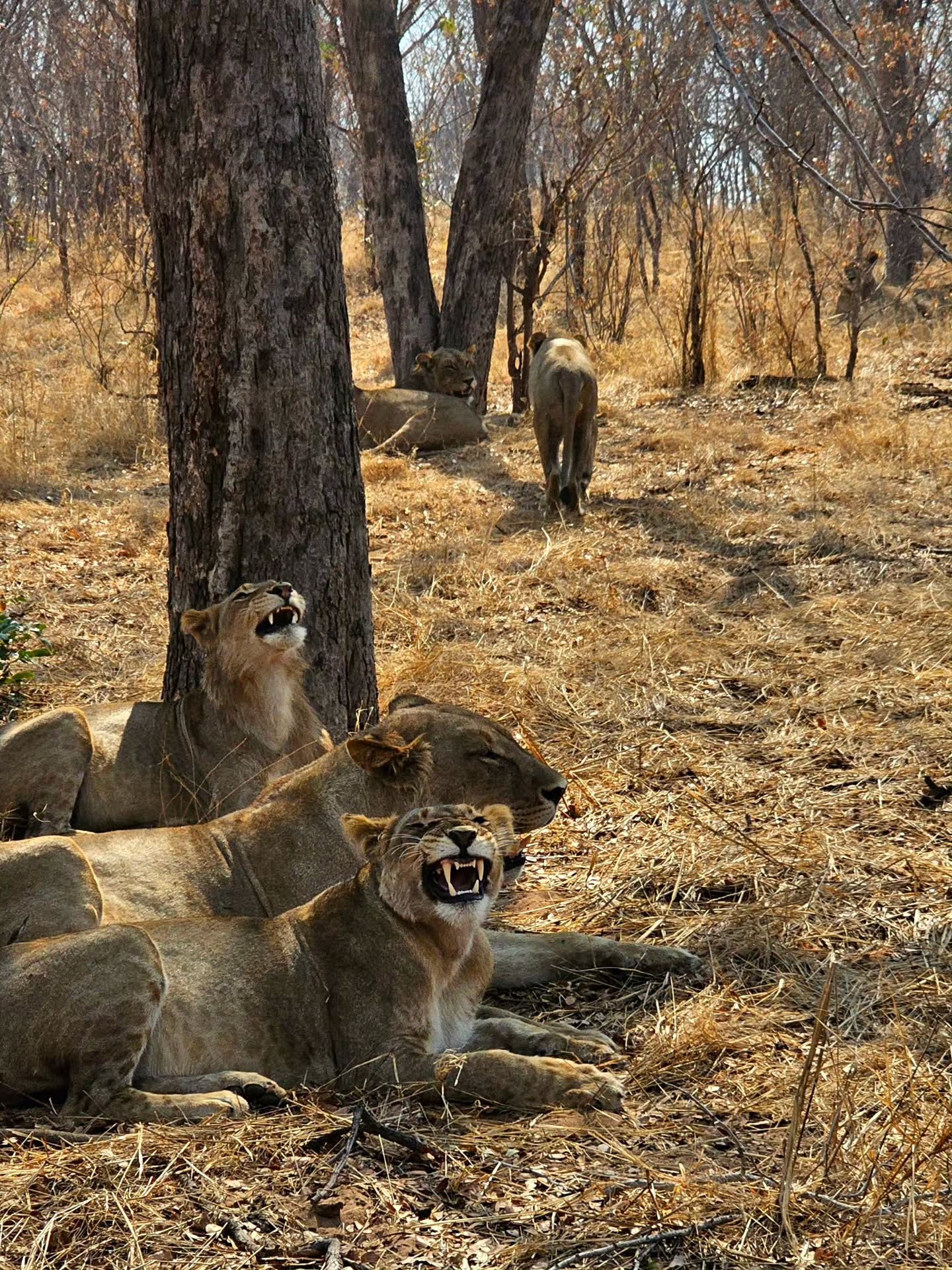
The lion prides of the Savuti Marsh have been documented hunting elephants, behaviour almost never recorded elsewhere in Africa. Savuti is one of the best places on the continent to see lions at work.
The Savuti Channel runs about 100 km yet drops only 18 m along its length. It flowed in Livingstone's time, was dry by 1880, and started running again in 1957 — for reasons still not fully understood.
The park's bird list tops 450 species, swelled each December–March by migrants from Europe and Asia, including carmine bee-eaters, storks and kingfishers hunting alongside the hippos.
From roughly November to March, huge zebra herds move between the Chobe/Linyanti rivers and the Makgadikgadi pans to the south — one of Africa's longest mammal migrations, and far less famous than the Serengeti's.
Chobe sits in the quad-border region where Botswana, Namibia, Zimbabwe and Zambia nearly meet. Victoria Falls is about 80 km from Kasane — an hour by road via the Kazungula Border Post.
Rock art by the San (Basarwa), the area's original hunter-gatherer inhabitants, survives in the rocky hills around Savuti — the oldest human record of the Chobe landscape.
Chobe carries an estimated 50,000 to 70,000 elephants — the densest concentration on Earth. Botswana as a whole holds 131,909 according to the 2022 KAZA Elephant Survey, the largest national population in the region. In the dry season, single herds on the riverfront can number well over a hundred animals.
The reserve was officially created in 1960 as the Chobe Game Reserve, then declared Botswana's first national park in 1967/68, the year after independence. The idea dated back to 1931, when a national park was first proposed, but a 1943 tsetse-fly infestation delayed it for over a decade. The park's first protection came earlier still: a 24,000 km² non-hunting area declared in 1932.
The park covers about 11,700 km² (4,500 sq mi) of northern Botswana, making it the country's third-largest park. It's part of the much larger Kavango–Zambezi (KAZA) Transfrontier Conservation Area spanning five countries. Despite the size, most day visitors only explore the Chobe Riverfront near Kasane.
It sits in Botswana's far north, with the Chobe River forming the boundary with Namibia's Caprivi Strip (Zambezi Region). The gateway town is Kasane, 8 km from the main Sedudu Gate and about an hour by road from Victoria Falls in Zimbabwe and Livingstone in Zambia. Four countries — Botswana, Namibia, Zimbabwe and Zambia — nearly meet at the park's doorstep.
The Chobe Riverfront (Serondela) in the northeast is the most visited, with dry-season elephant herds crowding the river. The Savuti Marsh in the west is famous lion and hyena country fed by the erratic Savuti Channel. The Linyanti wetlands hold the northwest, and the arid Ngwezumba pans, including Nogatsaa, sit in the quiet interior. Each region needs a separate drive — Kasane to Savuti alone is 195 km and 5–6 hours.
Above all, elephants — it has the densest population on Earth, and dry-season riverfront herds of 60-plus routinely cross the track within metres of vehicles. It's also known for its river cruises, the elephant-hunting lion prides of Savuti, more than 450 bird species, and its 2024 count of 276,400 visitors, which made it Botswana's busiest park.
Not yet. The Chobe–Linyanti wetland system is on UNESCO's tentative list, which is the formal first step toward a World Heritage nomination. Neighbouring Okavango Delta already has full World Heritage status, and the two are commonly combined on a Botswana safari.
Cape buffalo crowd the riverfront in the dry season, and lion, hyena, giraffe and leopard are all present. Savuti is especially good for predators — its prides have been documented hunting elephants. The Linyanti wetlands add red lechwe, and the park's 450+ bird species include African fish eagles, carmine bee-eaters and storks. Hippos and crocodiles are constant companions on any river cruise.
The San (Basarwa) hunter-gatherers were the area's original inhabitants, and their rock paintings still survive in the park's rocky hills around Savuti. After the park was proclaimed, industrial settlements — notably the Serondela timber camp — were gradually removed, and since 1975 the park has been entirely free of permanent human activity.
Permanent water along the Chobe and Linyanti rivers is the main draw, but history explains the density: wars and poaching in neighbouring Angola, Zambia and Namibia during the late 20th century pushed herds into northern Botswana, where they were protected. The population grew into the 50,000–70,000 estimated today — so many that they've browsed back much of the riverfront's hardwood woodland.
Browse verified tours with free cancellation and instant confirmation.
Find Tours